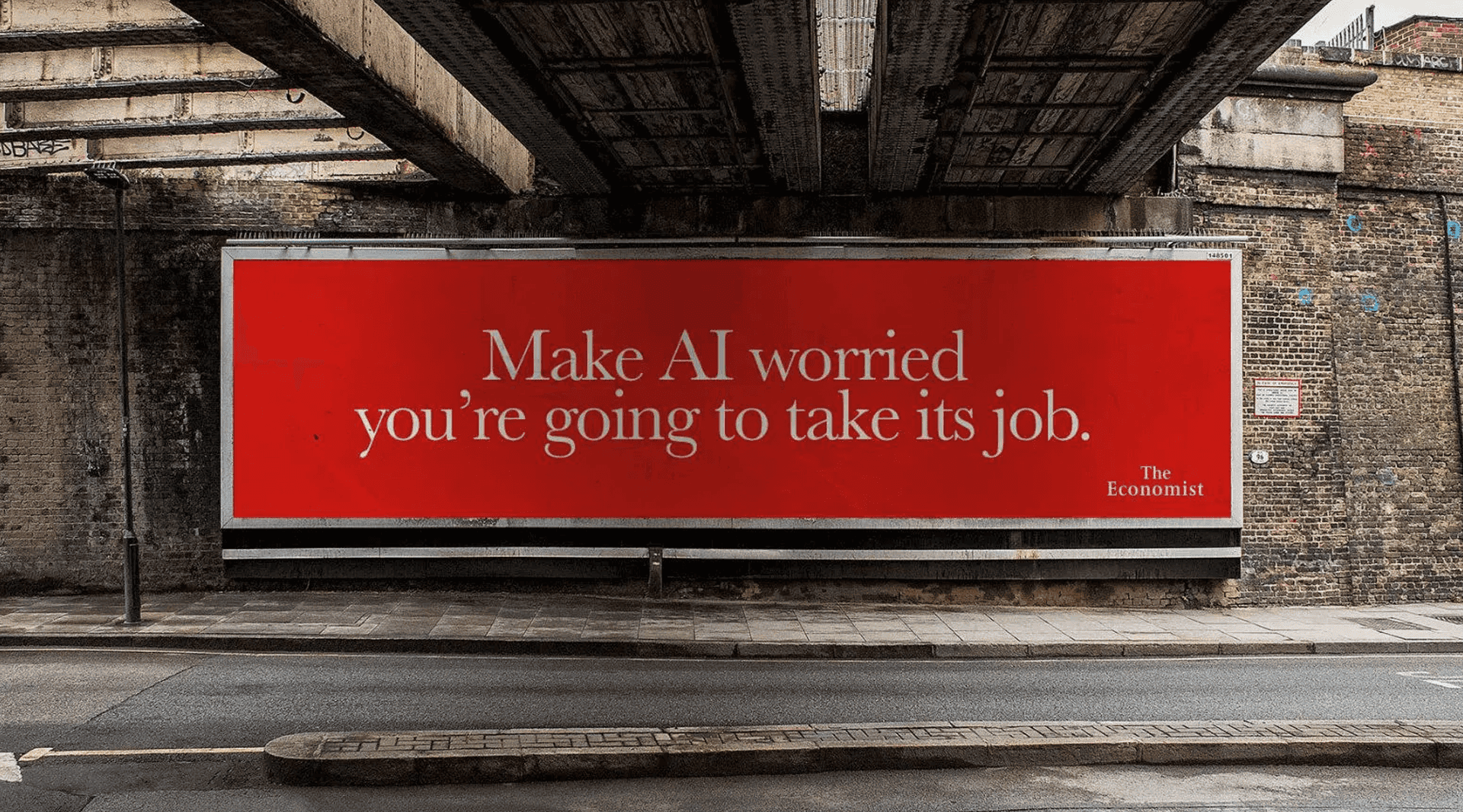
AI is of course absolutely everywhere. Its continued growth is high on the agenda in every facet of life. With it, anxious whispers about job displacement have become a common feature of the debate. This has spurred The Economist to return to its glorious past of creating punchy OOH ads. This time, they’re tackling the AI zeitgeist and what it means for the future of the workforce—an issue preying on the minds of employees and employers everywhere.
The publication is famous for its iconic, D&AD-winning 1991 slogan: “It’s lonely at the top, but at least there’s something to read.” It perfectly captured the CEO-based target audience of the age. Now, they’ve created a range of creative ads that flip the script on AI. They dare us mere humans to “Make AI worried you’re going to take its job.”
The campaign runs as a series of OOH special builds. The copywriting is pithy and beautifully captured. Billboards, plastered in The Economist’s classic font, carry the words: “Fake it ’til you make it to the newsagent”, “Take the ‘Humble’ out of IMHO”, and “Do you have an unprompted opinion?”.
The method is tried and tested, the message bold and clear. But what really stands out is the humanity. You can feel it in the insight and the craft of the campaign. It speaks directly to the typical Economist reader but also resonates with those of us in the creative industries. We read the words and are instantly transported. We can almost feel the process: the generation, the agonising, the refining, the second-guessing, and the final sign-off on these beautiful bits of language.
Eloquently delivered secondary messages accompany the lead slogans. One such message, “Read The Economist to supercharge your human intelligence,” neatly cements the proposition. It places The Economist on a pedestal of intellect of its own creation.
On so many levels, it’s an incisively delivered piece of work.
The inevitability of AI may loom large. We all struggle to harness its immense and ever-increasing power. Yet, this campaign makes the case for humanity and heart. It proves that good old-fashioned one-liners are still alive and well. For now, at least.